
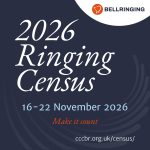
RINGING CENSUS – 16th-22nd November 2026
What does ringing look like today, and what will help it thrive in the future?
The 2026 Ringing Census aims to give the ringing community a clear, up-to-date evidence base for understanding where ringing is today and support informed choices about its future.
This is about much more than simply counting ringers. We want to understand who rings, where and how people participate, the health of our bands and towers, the skills and experience within the community, and what helps people to learn, progress and remain involved.
The Census has two complementary parts:
The Individual Census is about people. It will help us understand who our ringers are, how and where they ring, their skills and aspirations, what they value about ringing, and what encourages people to join, stay involved or return after a break. It also looks at the support ringers receive from their local Associations, Guilds and Districts.
The Tower Census is about places and bands. It will provide a picture of the health and sustainability of ringing at tower level, including band size and age profile, frequency of ringing, learners, recruitment and retention, reliance on visiting ringers, and the facilities and training resources available.
Together, the two perspectives should give us a much richer understanding of both the people who sustain ringing and the towers and bands through which ringing happens.
Census Week: 16–22 November 2026
An important part of the Census is a snapshot of what actually happens during the week of Monday 16 to Sunday 22 November 2026. The questions will include activity during that week, including ringing on Sunday 22 November.
You do not need to complete the Census during Census Week itself. The links to complete the Individual and Tower Censuses will be made available towards the end of Census Week and will remain available into the following week, so that you can report accurately on what happened between 16 and 22 November.
Your responses will help build a better picture of ringing today and provide evidence to support future decisions about recruitment, retention, training, development and support.
MEET THE CORE TEAM
Developing the Census is a small core team with significant expertise in developing the census and data analysis. You can find out more about them and their relevance to the Census here. Team Bios
There are others who are supporting the development of the Census for data protection and data analysis, as well as Enumerators and other support roles.
Find out more about the https://cccbr.org.uk/census/design/
YOUR PRIVACY
Protecting your personal information is fundamental to the project. The census has been designed in accordance with UK data protection legislation and follows recognised good practice for research projects. Personal information will be used only for the purposes of the census and will be handled securely. Results will normally be published only in aggregated form so that individuals cannot be identified. Further information about how your data will be collected, used and protected will be available in our Privacy Notice before the census opens.
Data Privacy Statement For a copy of the full Data Protection Impact Analysis, email us at
HOW YOU CAN HELP
You can help spread the word about the census within your ringing contacts, whether at your tower, district, across your association and ringing network.
To help with that we’ve developed a pack of information sheets and social media posts for you to use. You can download them from this zip file.
Delivering a successful census will depend on volunteers across the ringing community.
Census Enumerators
Enumerators will play an important role in helping us build an accurate picture of ringing across the country.
Each Enumerator will be allocated a small group of towers from our target sample and, after Census Week has ended, will:
- contact the Tower Captain or nominated tower contact
- encourage completion of the Tower Headcount Survey
- answer straightforward questions and provide practical support
- follow up where a return has not been received
- establish and record the status of towers unable to provide a return.
Our aim is for every tower in the target sample to be accounted for – whether it is active and completes the survey, has no active band, is currently inactive, or is unable to take part.
This follow-up is particularly important because it will help us understand non-response and produce a more reliable estimate of the total number of ringers and active towers.
Most Enumerator activity will take place in the second half of November 2026, after Census Week. Full guidance, templates and an online briefing will be provided.
There will be a number of briefing sessions for Enumerators to go through what is required and when. You will need to book on to one of them via these links, timings are UK:
Fri 6 Nov at 7.30pm: https://www.eventbrite.co.uk/e/1997442452144?aff=oddtdtcreator
Sun 15 Nov at 8pm: https://www.eventbrite.co.uk/e/1997442513327?aff=oddtdtcreator
Frequently Asked Questions will be updated regularly and available here.
Data analysts
We are also keen to hear from volunteers with experience in statistics, data science or survey analysis who would like to contribute to the design, analysis or interpretation of the results.
Data protection and governance
We are looking for one or two people with expertise in data protection, information governance or privacy to help ensure that the census meets the highest standards of fairness, transparency and security.
Interested in getting involved?
If you would like to support the Ringing Census 2026—as an Enumerator, data analyst, data protection adviser or in another capacity—we would be delighted to hear from you.
Please complete the volunteer registration form below.
AT A GLANCE
Census week: 16–22 November 2026 Census submission: 20 – 30 November 2026.
Who can take part? Bellringers of all ages worldwide
Time to complete: Approximately 15 minutes
Participation: Entirely voluntary
Results: Published in aggregated form to inform the future development of ringing